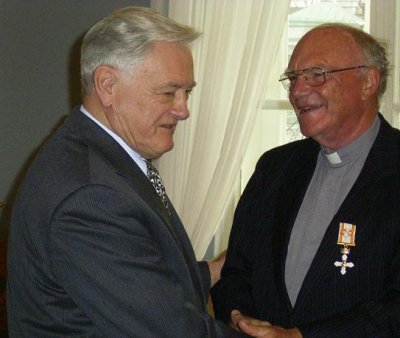
President Valdas Adamkus awarding Canon Bourdeaux the Officer’s
Cross of the Order of Lithuanian Grand Duke Vytautas the Great
Cross of the Order of Lithuanian Grand Duke Vytautas the Great
The exhibition’s antecedents were described in the August 2005 edition of Tiltas. Its aims were to demonstrate to Lithuanian society the colossal, but yet very little known, achievements of Keston Institute and Canon Michael Bordeaux, as well as the history of the Institute and its current activities.
One of the most striking items on display was a Memorandum drafted in 1972 and signed by more than 17,000 Lithuanian Catholics. The Memorandum was addressed to the General Secretary of the Central Committee of the Communist Party of the USSR Leonid Brezhnev. However, in order to attract the attention of the West to the fight for religious freedom in Lithuania, it was decided to submit the Memorandum via the United Nations. Despite surveillance by the KGB and militia, this document of 125 autographed sheets was compiled, successfully reached the West and was widely publicised. The Memorandum found its way to Keston via a clandestine route and is now held in their archive. This document is of inestimable historical value and gives evidence of the public spirit and personal bravery of thousands of ordinary Lithuanian believers. Members of B-LS had been able to see this document during their visit to Keston Institute in May 2004.
Also exhibited were copies of several petitions to the Communist Party leadership, signed by Lithuanian priests complaining about repression of religious freedom. A truly remarkable exhibit was the transcript of the trial proceedings of a member of the Baptist community, A. Skripnikova, that took place in Leningrad in 1967. The transcript is on several strips of cloth, easy to roll into small bundles and hide, illustrating the diverse ways used to smuggle information across the Iron Curtain.
Another group of exhibits consisted of periodicals and books published by Keston College (now Keston Institute) in the seventies and eighties, including Canon Bourdeaux’s book "Lithuania Land of Crosses: The struggle for religious freedom in Lithuania, 1939-1978", publicising the dire situation of the Church in Lithuania. Photographs and posters from exhibitions organised by Keston College also gave visitors a good understanding of the nature of this organisation’s activities and its significance to Lithuania.
Documents and other material from the Lithuanian Museum of Genocide Victims supplemented the exhibits from Keston. These reflected the manifestation of the believers’ rights movement in Lithuania, as well as by originals of "Lietuvos katalikų bažnyčios kronika (The Chronicle of the Lithuanian Catholic Church)". The ten volume set of the latter underground publication, reprinted by the Lithuanian diaspora in the United States, and its translations into many foreign languages were also on display, as well as abundant literature from the National Library collection reflecting the persecution of the Church in Lithuania and neighbouring countries. Yet another unique item was from the Genocide and Resistance Research Centre archive: a petition by the believers of Klaipėda requesting the return of their parish church, which had been confiscated by the Communist authorities and converted into a concert hall. The petition is in the form of a book some two inches thick, bound between poker-worked plywood covers.
The exhibits were attractively displayed in the main exhibition hall of the Martynas Mažvydas National Library, which is immediately adjacent to the Seimas, Lithuania’s parliament building. The National Library also published a beautifully designed brochure describing the achievements of Canon Bourdeaux, the work of Keston Institute, and highlighting some of the exhibits on display.
Exhibition Patrons were the Lithuanian Bishops’ Conference and the Organisers: Keston Institute, B-LS, Martynas Mažvydas National Library of Lithuania and the Genocide and Resistance Research Centre of Lithuania. Sponsors were the Lithuanian Ministry of Culture, British Embassy in Vilnius, Lithuanian Embassy in London, Lithuanian Association in Great Britain, Sir Sigmund Sternberg, Neil Taylor, Margo Maxwell Macdonald (The Westerly Trust) and the B-LS. As initiator and project manager of the exhibition, B-LS wishes to thank all those who contributed to its success, and particularly to Vytautas Gudaitis, Director of the National Library, and his talented staff for designing such a visually stunning display.