The main concern on New Year’s Eve and Day is to learn the future - what kind of year will it be, what will it bring and how will life go. Consequently, certain prognostications were performed on New Year’s Eve and the following day.
The vital question for a young girl was whether she would marry and would she find a beau and who will be her beloved or husband? Young men were also preoccupied with forming a family - would a girl fall in love with them, would they get a good, pretty, industrious and rich wife? The older folk wanted to know if the year would be good, prosperous and safe; would the harvest be bountiful, would livestock thrive and would there be storms? The old people yearned to know would they live one more year, would they be healthy, strong and wealthy?
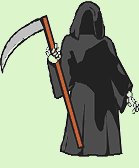
Giltinė
All family members met to celebrate New Year’s Eve, drank and ate. Men ran outside, talked nonsense, wrestled to see who is strongest, fell into the snow, but were not upset with each other. They also shot into the air to kill off the gone year. Young people revelled all night, awakened small children at midnight so they would not oversleep their good fortune. In the morning, they went to church and greeted each other after leaving church. Young men greeted young women and wished them a new spinning wheel, a new shuttle, good luck and a lover. Young women greeting young men, wished them a lovely girl, a bottle of vodka and a small glass. They would say: "This year you went on foot, may next year you ride; this year you walked in sandals, I wish you rides next year, wearing expensive shoes". The young men danced all night with pretty girls, so that they could do so all year. It is important at the start of the New Year to behave the way you would want to be for the rest of the year. If you are behind in your work on the first day of the year, you will be late for the rest of the year. No mending of clothes on this day, no borrowing or you will experience shortages throughout the year.
The weather and other events on New Year’s Eve and Day could also foretell the following year’s weather. If it snows on New Year’s Day, the weather will be bad all year. If the day is clear, the harvest will be good. If the trees are covered with frost, the year will be good but if there is a thick fog, people will die, epidemics and disease will rage. If it snows on New Year’s during the day, young people will die that year; if it snows that night, old people will die. If it’s cold on New Year’s Day, Easter will be warm. If many magpies gather in the yard on New Year’s Day, there will be many guests during the year and the year will be a happy one. If it snows in huge snowflakes, cows will give much milk. Should a woman be a first visitor, it will be an unlucky year. If it’s a man, a lucky year. If a Jew, a very lucky year.
People would try to be careful on New Year’s Day for their actions that day would determine their behaviour all year. Family members were kind to each other and would not argue or fight, would smile a lot and help one another. Husbands and wives shared an apple in order to erase all their disagreements and to be congenial. Children were good so their parents would not scold or punish them for this will continue into the following year. If a person falls on New Year’s Day, they will be unlucky all year.
Whatever news is heard on New Year’s Day will determine the whole year - if the first news heard is good, the year will be good. If the news is bad the entire year will have much bad news and sorrow.
On New Year’s Eve, many of the auguries and forecasts done on Christmas Eve were repeated. Most of them were associated with weddings.
Girls ready for marriage would pull a tree branch out of a pile - if the branch has many twigs, she’ll marry a rich man. Girls at midnight would light 12 candles in the dark pantry, place a mirror among them and stare into the mirror until they see a male face which means marriage this coming year. If no face appears, they will spend another year working in the grain fields.
A girl picks up a handful of nuts and if there is an even number of nuts, there will be a wedding. A girl places a comb or a padlock under her pillow and the man who combs her hair or unlocks the door in her dream will be the one who will become her husband. A girl would place her lover’s hair together with hers on the table and set it on fire. If her lover’s hair twists and turns while burning - they’ll marry. If not - no wedding. A girl scatters oats outside and he who comes in a dream to harvest the oats, will be her husband.
At midnight, a glass filled with water is placed near a mirror. A dead person’s wedding ring is dropped into the glass and stirred with stork feathers. While stirring, she hopes to see the face of the new husband in the centre of the ring. Nine days before New Year, every evening a girl would count nine stars, on the ninth night, she would place a towel on her head, stand in front of the dark window and expect to see her future husband. Upon first seeing the new moon, a girl should not move. She should look what is under her feet, a stone or a sliver of wood, pick it up, keep it until the last day of the year then place it under her pillow. In her dream, on New Year’s Eve, she will see her future.
People would crumble a piece of paper and set it on fire then look to see what its shadow portrays. If the burned paper looks like a wagon, it means a trip; if like a house, you’ll have another home; if like a casket, it means death. The first thought is the one that counts.
A girl writes 12 male names on 12 pieces of paper (one for every month of the year) and leaves a thirteenth blank. She folds the papers and places them under her pillow. Next morning she pulls out the first piece her hand touches and that’s the person she’ll marry. If she gets the blank piece, she will be alone that year and no one will love her. If she awakens during the night before dawn, she must reach for a paper at that time but she must not turn on the light to read it. She must place it next to her bed and read it by daylight. Men would also use this method of fortune-telling but would write 12 female names and follow the same procedure.
Cards with various words on them are put into a bowl of water with a candle on a box floating in the bowl. The card closest to the candle when it stops will determine your fate. Some people set dry tree branches in the snow. If in the morning someone’s branch has fallen over, he will die before the next New Year. Bubbles in a spoonful of sweetened water in the New Year mean that person will have a long life.
The last time in the year when a girl receives flowers, she must dry, crush them thoroughly and set it aside. On New Year’s Eve the flowers are burned and a pinch of the ashes sprinkled into a glassful of water and the glass placed on a table covered with a white cloth with two candles lit on either side. She then stirs the water and looks to see if a male form is on the bottom. If there is, she will marry in the New Year.
When going to sleep before New Year, pour salt on the corner of the table nearest the bed. If the salt is wet in the morning, you will die that New Year; if the salt is dry, you will continue living.
A key, ring, small water goblet and coin are placed under overturned bowls. The bowls are mixed and everyone chooses one in turn. The one who finds the ring will marry that year; whoever finds the water will have a drunk for a spouse; the key means owning a house, the coin signifies wealth.
Although Lithuanian hospitality did not preclude alcohol during such festivities, the mood depended more on games, predictions and jokes than on the amount of alcohol consumed and the fun was more of the family variety where all guests were also included in the games and auguries, thereby creating a happy and pleasant atmosphere.
Extract from Danutė Brazytė Bindokienė, Lithuanian Customs and Traditions, and Anthology of Lithuanian Ethnoculture, Internet